
Preservation
A primary component of Greenvale’s mission is the preservation of it’s historic grounds and structures.
While the vineyard operates to preserve the historic landscape, the buildings at Greenvale have been maintained and restored to provide visitors a cultural time capsule of historic New England.
Architect Rendering Wilson Architects 1999
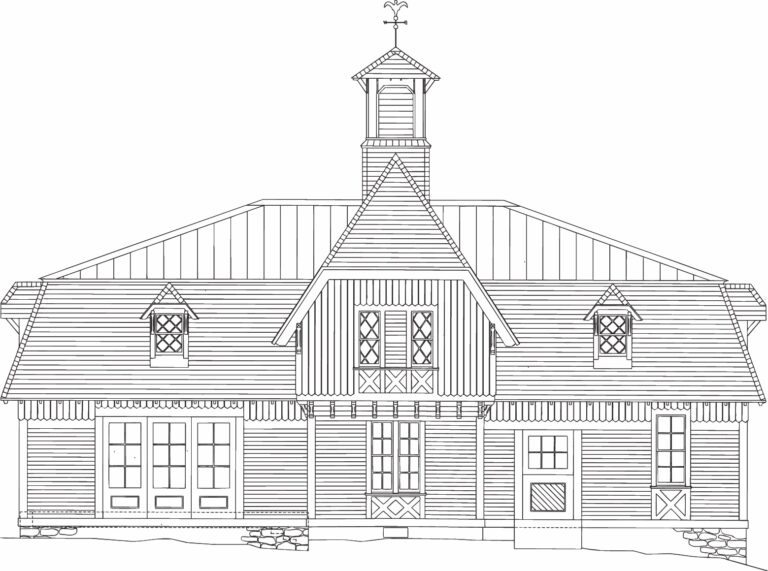
The Stable (1863)
Built in 1863, the stable originally served not only as a carriage house but also as an architectural prototype for the house built shortly after, 1865. The style, known as “Stick Style,” is expressed through asymmetry, exposed framing members and “X’s” beneath the windows. The 40 X 60 structure provided three levels of space, an upper hayloft, a central level for horses and carriages and a lower level for tools. By the 1990’s, the stable was deteriorating and the vineyard was in need of a venue in which to serve our newest crop: wine. So with the help of Wilson Architects, Boston, and Jenkins Construction, Middletown, we restored the stable to become our tasting room. Work included regrading to insure handicap access, removal of the collapsing hay loft and a new truss system to support the expansive roof. The 40 X 60 structure provided three levels of space, an upper hayloft, a central floor for horses and carriages and a lower level for tools.
Although it is a great venue for tastings, concerts and events, the original horse stalls still stand and are used as employee work spaces.
The Farm (1863)
One enters the original farm from a long driveway off of Wapping Road, passing our newest vineyards on Greenvale’s western edge and neighboring farmland. Visitors pass through a white fence and discover the stable and Farmhouse amidst the vineyards on the north and south sides of the driveway. The lane continues through the Red Gates to the Main House which is open only for private events.
The “County Life” concept proposed a farm setting that was purposeful productive agriculture, organized around ornamental driveways and living structures.
The Main House (1865)
The picturesque architecture of the main house consists of delicately scaled jerkin headed rook forms in a diagonally patterned slate roof with vertical brick chimneys. The two-story structure presents dynamic views on all four sides and creates an impression of both a working farm and a secluded retreat.